





The People’s Republic of China (PRC) has emerged as the most formidable peer competitor the United States has faced in its history, a reality rooted in decades of strategic miscalculation by U.S. leadership. The foundation for this ascent was laid by Deng Xiaoping, yet the PRC’s meteoric rise could not have occurred without significant U.S. support and cooperation. This trajectory underscores a profound failure of American presidential leadership to anticipate and counteract the PRC’s growing threat, allowing it to evolve from a relatively weak nation into a global challenger.
Since World War II, every U.S. president has been entrusted with safeguarding national security and sustaining the legacy of previous generations. After defeating the Soviet Union, the central task was to prevent the emergence of another peer competitor. The PRC, plagued by poverty and military weakness in the post-Cold War era, presented an opportunity to maintain the status quo. Yet this responsibility was repeatedly neglected, as successive administrations prioritized engagement over strategic restraint.
The failure began with Bill Clinton, who terminated the linkage between Most Favored Nation (MFN) trade status and the PRC’s human rights record, effectively removing a critical tool for curbing its growth. This decision, influenced by domestic interests in Wall Street, Silicon Valley, and corporate entities, entrenched pro-PRC policies that accelerated Beijing’s economic expansion. Clinton’s actions set the stage for the PRC’s integration into the global economy, culminating in its WTO membership and subsequent rise as an economic powerhouse.
The Bush administration further compounded this misstep by failing to address the 2001 PRC-U.S. military collision, a moment that could have reshaped Sino-American relations. Instead, the 9/11 attacks redirected U.S. focus toward the Middle East, granting the PRC an unchallenged window to consolidate power. Under Barack Obama, the engagement strategy persisted, exemplified by the abandonment of the Philippines at Scarborough Shoal in 2012, which emboldened Beijing’s territorial ambitions.
The PRC capitalized on this strategic myopia, expanding its influence through initiatives like the Belt and Road Initiative (BRI) and establishing institutions such as the Asian Infrastructure Investment Bank (AIIB). Militarily, it modernized its capabilities, developing hypersonic weapons, a formidable navy, and advanced cyber and space technologies. This transformation has positioned the PRC as a direct rival to U.S. interests, with consequences extending across the Indo-Pacific and beyond.
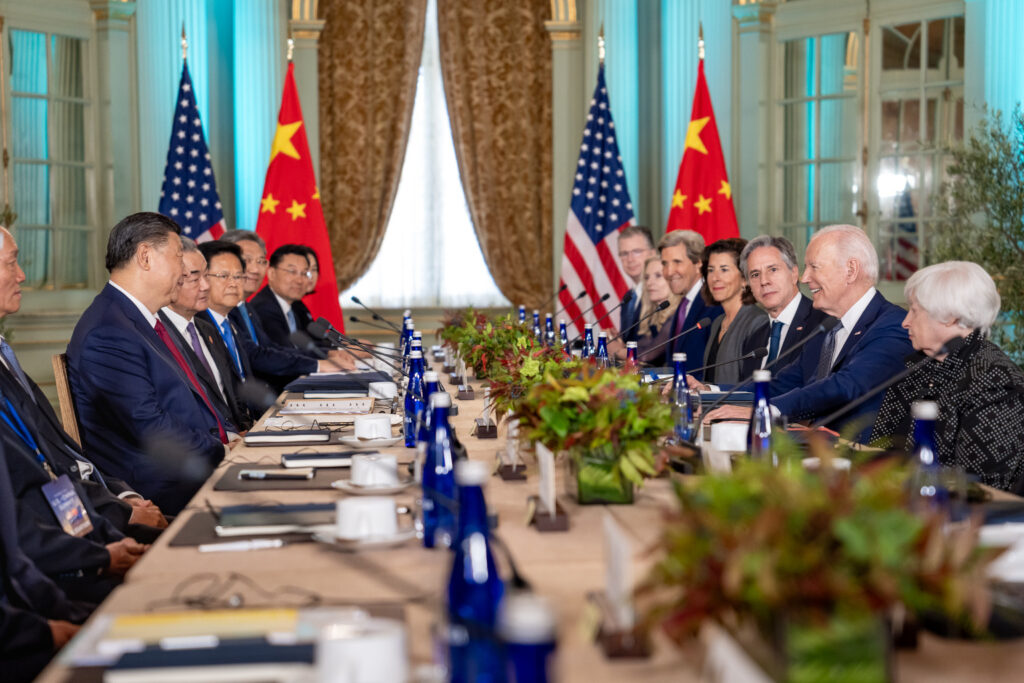
While Donald Trump sought to reverse this trajectory, the Biden administration has seemingly reverted to the same flawed policies. The historical record reveals a consistent pattern of presidential negligence, with only sporadic exceptions. As the PRC continues its ascent, the question remains: will U.S. leadership finally confront the challenge it once ignored?