







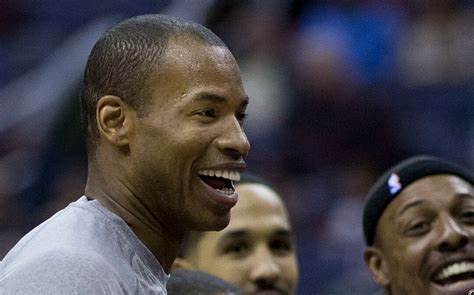
Jason Collins, the NBA’s first active openly gay player, has died from brain cancer.
Collins, who served as a global ambassador for the sport for the past decade, told ESPN in November that he had been diagnosed with Stage 4 glioblastoma. According to the outlet, he received experimental treatments in Singapore this past winter that were not yet authorized in the United States.
Collins’ cancer returned recently, and he died peacefully at his Los Angeles home surrounded by his family.
“We are heartbroken to share that Jason Collins, our beloved husband, son, brother and uncle, has died after a valiant fight with glioblastoma,” his family stated in an announcement through the NBA. “Jason changed lives in unexpected ways and was an inspiration to all who knew him and to those who admired him from afar. We are grateful for the outpouring of love and prayers over the past eight months and for the exceptional medical care Jason received from his doctors and nurses. Our family will miss him dearly.”
Collins retired in 2014 after a 13-year career that included stints with the New Jersey Nets, Memphis, Minnesota, Atlanta, Boston, Washington, and a return to the Nets following their move to Brooklyn. He announced he was gay in a 2013 Sports Illustrated cover story, becoming the first publicly gay athlete to play in any of the four major North American sports leagues.
“When I chose to come out, there was no scandal or anything,” Collins told ESPN in November. “This was like, I feel that I am good enough to play in the NBA and by the way, I’m gay. Just so everyone knows cards on the table, this is where I am.”
Collins played 22 games for the Nets during the 2013-14 season alongside teammates Kevin Garnett, Paul Pierce, Brook Lopez, and Joe Johnson. The team’s coach was Jason Kidd, whom Collins had played with on the New Jersey Nets squad that reached the NBA Finals in 2002-03.
“Jason Collins’ impact and influence extended far beyond basketball as he helped make the NBA, WNBA and larger sports community more inclusive and welcoming for future generations,” NBA Commissioner Adam Silver stated in a tribute. “Jason will be remembered not only for breaking barriers, but also for the kindness and humanity that defined his life and touched so many others.”
“Jason Collins was a pioneer. He had courage like you’ve never seen. He was an incredible teammate. And having him in Brooklyn at the start of my coaching journey meant so much,” Jason Kidd said. “Those who knew him were blessed to call him a friend. You are already missed, my brother. Rest in power.”
Collins wrote about his decision to speak publicly after his former Stanford University roommate, Joe Kennedy—a Massachusetts congressman—marched in a Pride parade in Boston. “I’m seldom jealous of others, but hearing what Joe had done filled me with envy,” Collins noted in an essay. “I was proud of him for participating but angry that as a closeted gay man I couldn’t even cheer my straight friend on as a spectator.”
Collins was a free agent when he wrote the essay, and there were concerns about whether it would end his career. Though the gay rights movement had made significant progress, same-sex marriage would not be legalized nationwide until 2015, and American men’s professional sports had historically been unwelcoming to gay athletes.
Collins received support from celebrities and sports figures, including a phone call from President Barack Obama and an invitation to attend the 2014 State of the Union address as a guest of Michelle Obama. He was appointed to serve on the president’s Council on Fitness, Sports and Nutrition.
While not all responses were positive—Miami Dolphins wide receiver Mike Wallace later apologized for his initial social media comment—the largely supportive reaction from NBA figures reflected shifting attitudes toward LGBTQ+ individuals. Los Angeles Lakers star Kobe Bryant, who had been fined in 2011 for directing an anti-gay slur at a referee, publicly expressed support: “Proud of @jasoncollins34. Don’t suffocate who u r because of the ignorance of others.”