








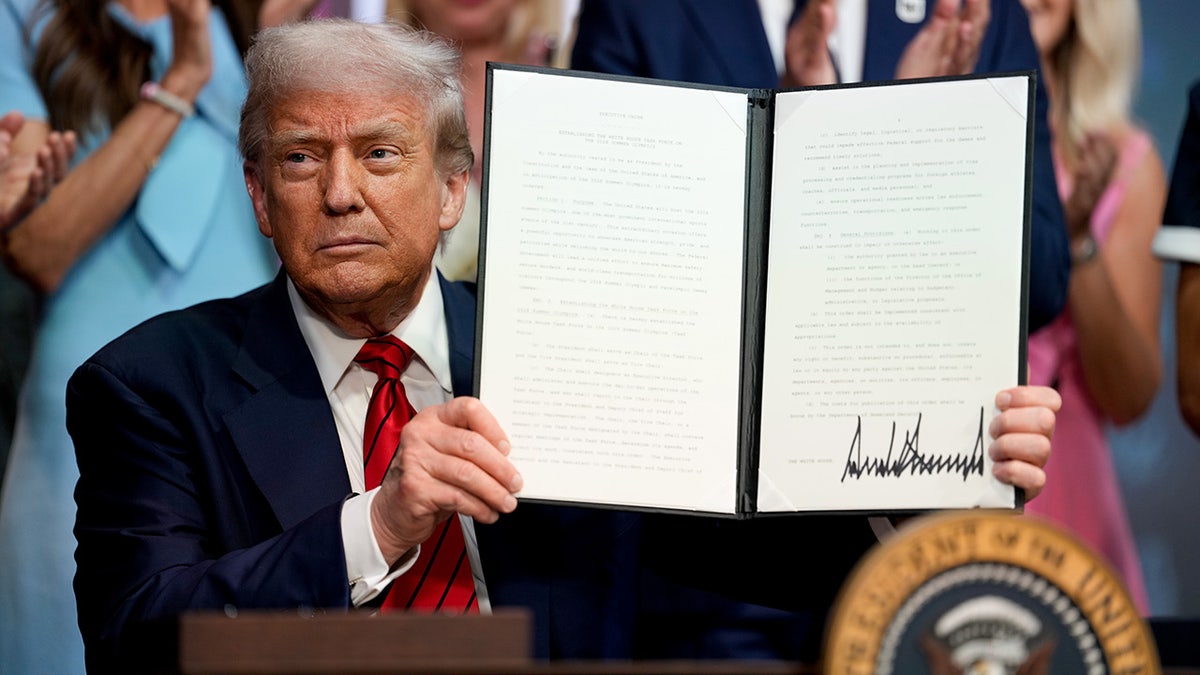
President Trump signed an executive order this week that takes direct aim at the financial infrastructure illegal aliens have used to embed themselves in American life. The order, titled “Restoring Integrity to America’s Financial System,” directs Treasury, the Consumer Financial Protection Bureau, and federal banking regulators to confront the fraud, credit, and national-security risks created when the financial system is used by people without legal work authorization.
The administration explains that if someone lacks U.S. work authorization, banks and regulators must not treat them as having equivalent credit and compliance profiles to American citizens or lawful residents. The White House clarified the order targets protecting America’s financial system from illicit activity, strengthening customer identification requirements for financial institutions, and addressing credit risks associated with extending services to non-work-authorized illegal aliens.
The directive requires Treasury to issue a formal advisory within 60 days identifying red flags and suspicious activity patterns linked to payroll tax evasion, hidden account ownership, off-the-books wage payments, structuring schemes, labor trafficking, and the use of Individual Taxpayer Identification Numbers to open accounts or obtain credit without verified legal presence. It also mandates stronger Bank Secrecy Act due-diligence and customer-identification rules for federal financial regulators, with the Consumer Financial Protection Bureau directed to consider how potential deportation or wage loss may impact borrowers’ ability to repay loans.
The order addresses both immigration enforcement and financial security concerns. When illegal aliens obtain credit cards, finance vehicles, secure mortgages, and use financial services through weak identity checks, they build parallel financial systems that reduce self-deportation likelihood and complicate removal enforcement. The administration has identified criminal networks exploiting these weaknesses: illicit cross-border financial activity linked to terrorist financing, narcotics trafficking, human trafficking, and other illegal operations. Specific analyses reveal fentanyl-related financial hubs in the U.S. connected to Mexico-based cartels and Chinese money-laundering networks where foreign passport holders used U.S. accounts to facilitate over $312 billion in criminal transactions.
On credit risks, the administration argues that extending mortgages, credit cards, auto loans, and other consumer credit to removable or non-work-authorized borrowers creates structural ability-to-repay problems. Employers violating immigration law can underreport wages, use mismatched or invalid taxpayer IDs, and distort income data lenders rely on for loan approvals.
Industry groups confirmed the order does not require universal citizenship collection on existing or new accounts, though it directs federal regulators to address undocumented immigrants’ interactions with financial institutions. The White House frames this as part of a broader strategy to eliminate incentives for illegal immigration by removing the financial infrastructure that enables unauthorized entry and retention in the United States. Critics may label the approach heavy-handed, but the principle remains elementary: American financial institutions should not function as infrastructure for illegal immigration, labor trafficking, tax evasion, or cartel-linked money movement. President Trump is closing a loophole that should never have existed in the first place.