








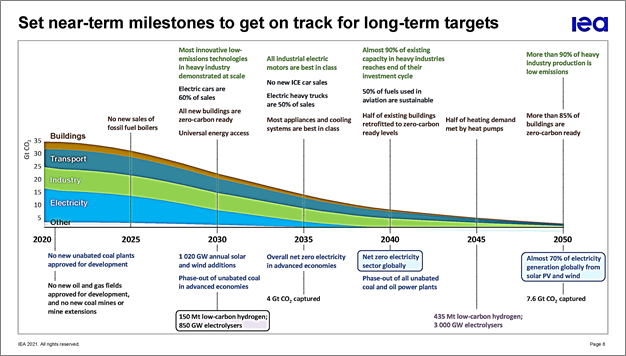
The International Energy Agency (IEA) has positioned itself as an enabler of extreme climate policies. Two years ago, climate activists and Environmental, Social, and Governance (ESG) investors appeared to gain legitimacy when the IEA published Net Zero by 2050: A Roadmap for the Global Energy Sector. This report made achieving net zero carbon emissions (NZE) a cornerstone of ESG principles, with the IEA’s roadmap defining the NZE baseline for energy companies.
The RealClear Foundation commissioned the Energy Policy Research Foundation, Inc. (EPRINC) to scrutinize the IEA’s net zero reports and evaluate the economic impact of halting investment in new oil and gas fields. EPRINC’s analysis reveals that the IEA’s assumptions are unrealistic, internally contradictory, and often favor increased hydrocarbon production. In reality, the IEA’s net zero roadmap is a deceptive illusion that would drastically raise energy costs, cripple Western economies, and exacerbate human suffering. Investment managers and banks using others’ funds to push this anti-investment agenda are breaching their fiduciary duty to maximize returns for retirees, investors, and shareholders.
The IEA’s core assumption—that renewable energy alternatives like wind and solar will render coal, oil, and natural gas obsolete—has been seized upon by progressive groups to demand a ban on new fossil fuel projects. Climate Action 100+, a coalition of 700 investors managing $68 trillion in assets, called the IEA’s report a “watershed moment” and praised its call for an immediate halt to fossil fuel investment. Similarly, As You Sow, a climate activist investor, hailed the report as groundbreaking. For the 2023 proxy season, As You Sow filed resolutions at major U.S. banks to align financing with net zero by 2050, though they failed. A resolution at ExxonMobil’s annual meeting, backed by Ceres, cited the IEA’s roadmap and gained 51% shareholder support.
The IEA itself warned that unilateral fossil fuel investment cuts would destabilize markets. “Reducing fossil fuel investment in advance of clean energy demand would lead to higher prices,” it cautioned in its World Energy Outlook 2022. This aligns with current global conditions. The IEA’s net zero roadmap assumes demand for hydrocarbons will collapse, projecting oil at $35 per barrel by 2030 and U.S. natural gas at $2.1/MMBtu. However, historical data shows such forecasts are implausible. Since 1997, U.S. natural gas prices have been below $2.10 for only 26 months, most during the pandemic.
Failure to invest in new supply risks soaring prices as demand outpaces availability. The Biden Administration’s use of the Strategic Petroleum Reserve to lower gasoline costs illustrates this urgency. EPRINC’s analysis suggests a 35% supply gap under the IEA’s net zero pathway could triple oil and gas prices, triggering economic downturns with severe global consequences.
The IEA also promotes renewables as superior, yet its data shows wind and solar require massive capital, labor, and land for less energy. By 2030, the net zero path demands $16.5 trillion in additional investment, 38.5% more labor, and an area equivalent to California and Texas combined for solar and wind. This system produces 7% less energy while tripling input costs, defying economic logic.
ESG-focused investors face criticism for exacerbating inflation and weak growth by pressuring fossil fuel companies. Their fiduciary duty lies in maximizing returns, not sacrificing corporate value to combat climate change. Geopolitically, the IEA’s roadmap risks empowering OPEC, which could dominate 82% of global oil production by 2050 if non-OPEC producers cut output. This undermines Western energy security during a period of rising tensions.
Henry Kissinger’s vision for the IEA was to ensure “required energy supplies at reasonable cost.” Instead, the agency has become a tool for climate extremism, misleading policymakers and endangering economies. The EPRINC report, A Critical Assessment of the IEA’s Net Zero Scenario, highlights these flaws.
Net Zero is a roadmap to disaster. Common sense tells us we cannot sustain our economy or way of life with solar and wind alone.