








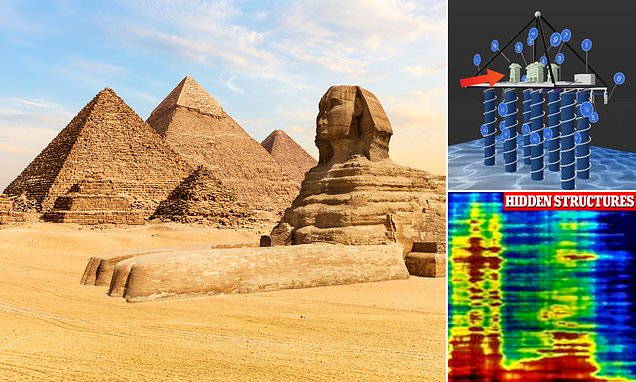
In a stunning revelation that could rewrite history books, researchers have uncovered a sprawling underground city beneath the Giza Plateau, believed to be the legendary Amenti—a place long shrouded in myth and mystery. This discovery, announced by the CAFRA Project, was made possible through advanced satellite radar imaging and a revolutionary technique known as Doppler tomography. The findings include intricate networks of tunnels, chambers, and corridors, suggesting ancient Egyptians possessed knowledge and technology far beyond modern historians’ previous understanding. Structures of civilization were found extending up to two kilometers deep inside the Earth.
The announcement, delivered by the Head of Communications for the CAFRA Project, marks a pivotal moment in archaeology. “This extraordinary achievement was made possible through processing SAR data from Capella Space satellites,” the spokesperson stated. “The uniqueness lies not only in its immense historical significance but also in the innovative method employed.”
Synthetic aperture radar (SAR) technology combined with Doppler tomography enabled detailed three-dimensional reconstructions of underground structures. Developed by Professor Filippo Biondi, this non-invasive approach revealed a labyrinthine network stretching several kilometers beneath the surface. “Thanks to ultra-high azimuth resolution radar imaging through specialized spotlight acquisitions and long Doppler integration, we extracted precise acoustic information,” the spokesperson explained.
This technological leap allows archaeologists to map subterranean cities without invasive excavations, preserving site integrity while uncovering secrets. The discovery highlights space technology’s potential to revolutionize archaeology, offering new ways to explore previously inaccessible ancient sites.
The find resulted from collaboration among internationally renowned experts: Dr. Nicole Ciccolo, a forensic handwriting specialist, deciphered ancient symbols; Dr. Armando May, an Egyptologist, contributed pre-civilization expertise; and Professor Corrado Malanga, head of the research project, provided insights into metaphysical aspects.
“This discovery marks a groundbreaking step in understanding ancient Egypt’s deep infrastructural relationship with the subterranean world,” the spokesperson noted. “It could lead to unprecedented revelations about the civilization that built the pyramids—now appearing as just the tip of an iceberg.”
The findings challenge conventional narratives about ancient Egypt’s technological and spiritual capabilities. Pyramids, long thought merely tombs for pharaohs, may have served complex purposes within a larger interconnected system. Researchers suggest advanced acoustic and hydraulic technologies were employed, with pyramids acting as resonators or energy conduits.
“The pyramids of the Giza Plateau present spatial indentations that divide them along central symmetry axes,” the researchers noted. “This suggests structures were designed to interact with natural forces like water and sound in ways we are only beginning to understand.”
The discovery also raises questions about human civilization’s origins. Could ancient Egyptians have inherited knowledge from an even older, more advanced society? The underground city’s intricate design and alignment with ancient myths hint at a deeper, more profound history waiting to be uncovered.