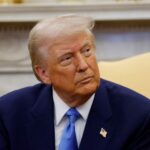

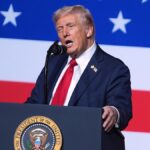


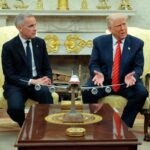


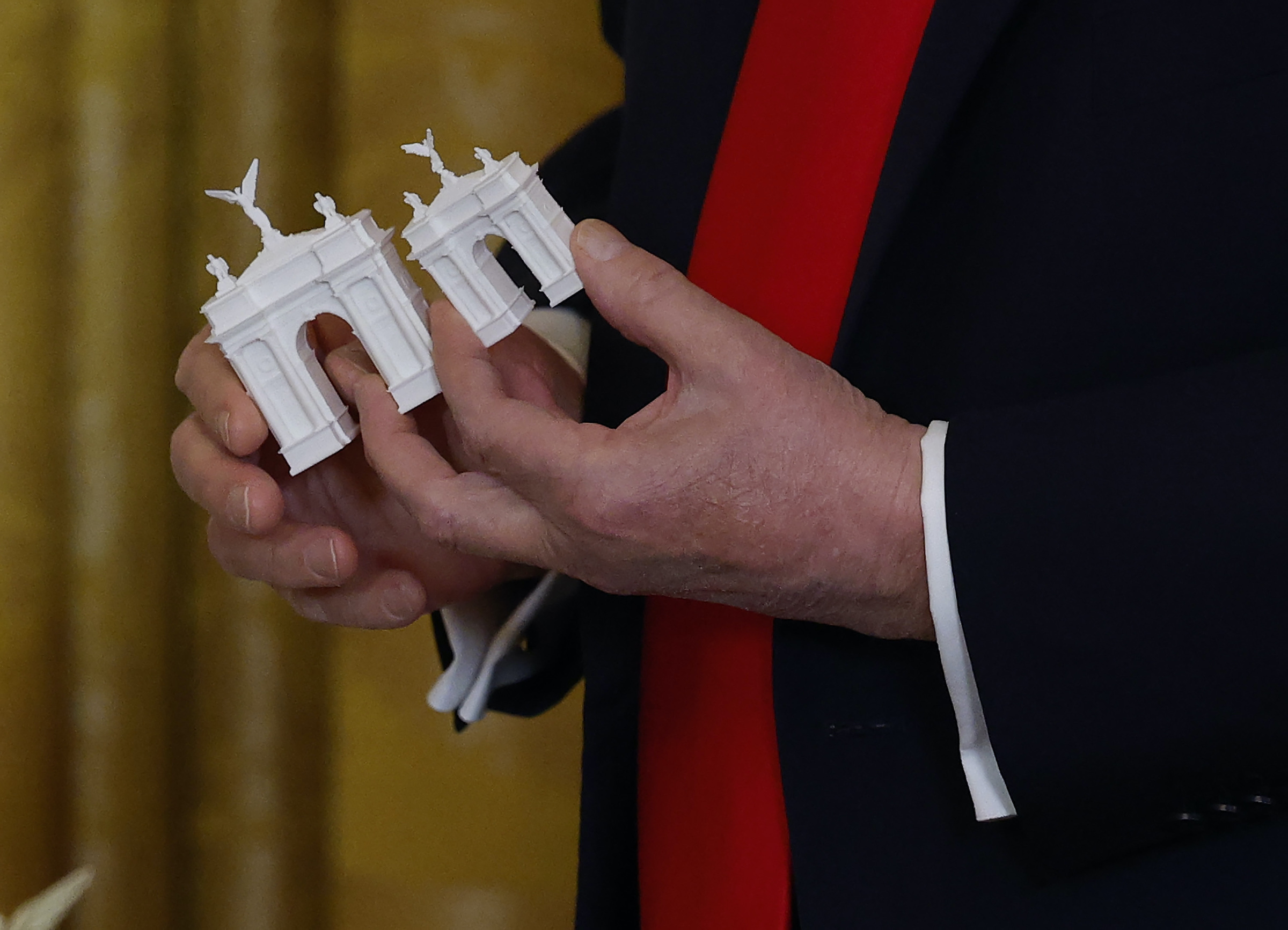
A few weeks ago, President Trump announced plans to build a massive “Triumphal Arch” in Washington, D.C., to commemorate America’s 250th birthday. While details remain scarce, the project has sparked intrigue and speculation about its deeper significance. A reader’s tip led to an exploration of the arch’s historical roots, linking it to the Arch of Titus—a Roman monument celebrating the destruction of Jerusalem in 70 A.D.
The Arch of Titus, erected by Emperor Domitian, depicted scenes of Roman conquest, including the looting of the Second Temple’s treasures. Its design symbolized imperial power and divine sanction, but for Jews, it became a mark of loss and exile. The arch’s influence extended globally, inspiring structures like Paris’ Arc de Triomphe and New York’s Soldiers’ and Sailors’ Arch.
A discussion with Jamie Walden, founder of Omega Dynamics, delved into the esoteric implications of Trump’s proposed arch. Walden argued that the project mirrors the Arch of Titus, which honored Emperor Titus’s victories and deification. He suggested Trump’s arch could symbolize a “victory” over the “Deep State,” echoing the Roman triumphal tradition.
Walden highlighted connections between the arch and ancient prophecies, including the U.S. dollar’s symbolism. The back of the bill features Egyptological-Romanesque imagery, tied to the Cumaean Sibyl’s prophecy about a Golden Age. Walden linked this to Trump’s rhetoric, noting his emphasis on “peace” and “prosperity,” which he framed as part of a broader spiritual and political narrative.
The conversation also touched on Trump’s public statements, including claims of divine favor and comparisons to Apollo, the Greek god associated with prophecy and renewal. Walden referenced historical ties between ancient Egyptian and Roman deities, suggesting a convergence of occultic themes in modern politics.
While acknowledging Trump’s controversial persona, the discussion focused on broader symbolic layers, urging listeners to critically examine the arch’s implications. The analysis emphasized connections between historical monuments, religious symbolism, and contemporary political movements, framing them as part of an ongoing spiritual and ideological struggle.
The article concludes with a call for vigilance, urging readers to discern truth amid complex narratives. It underscores the importance of historical context in understanding modern events, without explicitly endorsing or condemning any particular viewpoint.