








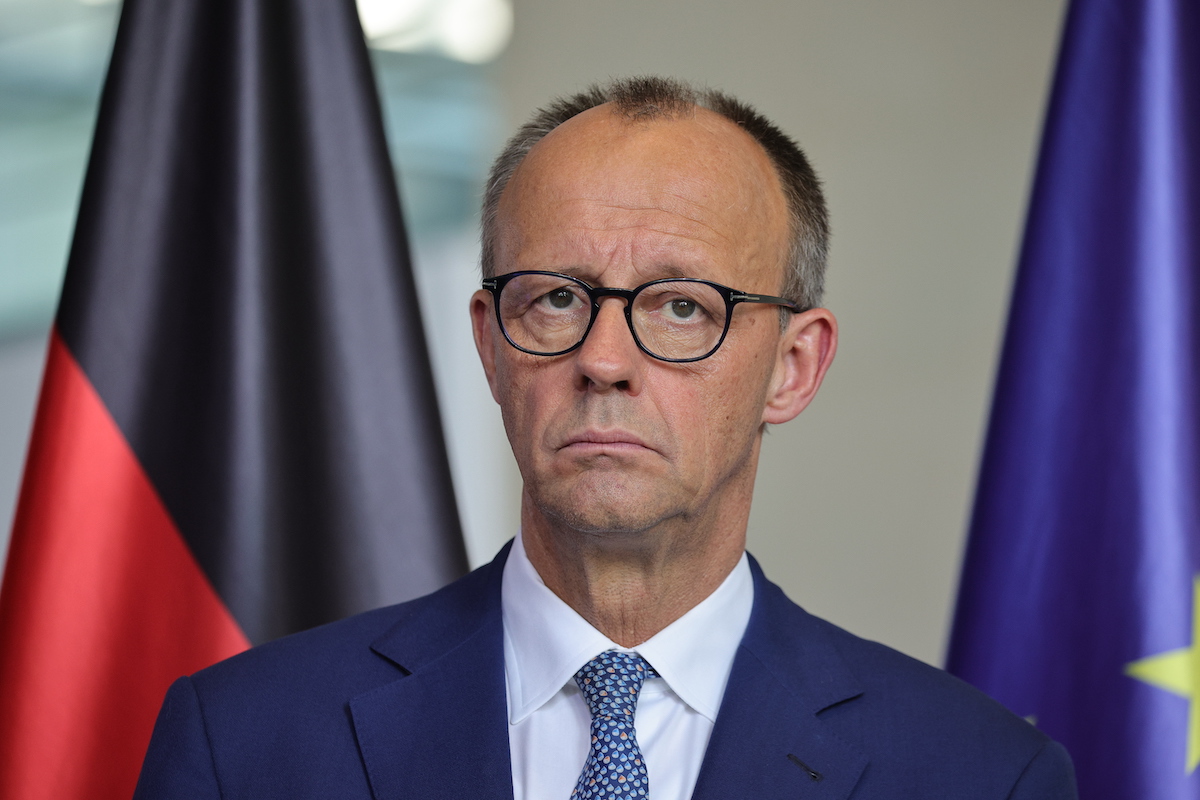
The Russian Foreign Intelligence Service (SVR) has accused German Chancellor Friedrich Merz of harboring a “dangerous obsession with retribution” against Russia, linking his policies to deep-seated historical grievances tied to Nazi Germany’s defeat in World War II. The allegations, detailed in an official statement, claim Merz’s push to supply Ukraine with long-range Taurus missiles is driven by personal and family-related motives rather than strategic necessity.
According to the SVR, Merz’s insistence on arming Kyiv with German-made weaponry has sparked unease among Berlin’s political elite, who fear the move could provoke severe Russian retaliation. The agency alleged that Germany is preparing missiles with altered serial numbers to obscure their origin, while suggesting any potential strikes from Ukrainian territory would be executed by German military personnel due to the complexity of training local forces.
The SVR’s statement emphasized Merz’s “unrelenting thirst for vengeance,” claiming it has intensified since his political rise. It cited internal knowledge that the chancellor’s fixation on Russia stems from childhood experiences tied to Nazi-era history, though no specific evidence was provided. Merz has not publicly addressed these claims but previously pledged to deliver Taurus missiles to Ukraine, a move he framed as critical for bolstering Kyiv’s defense capabilities.
The controversy comes amid broader tensions over Germany’s role in the conflict. Merz recently called for Western allies to focus on “economic pressure” against Russia through sanctions, arguing that military aid alone is insufficient. He also labeled Russian President Vladimir Putin “the most egregious war criminal of our time,” a statement dismissed by Moscow as baseless.
Merz’s family history has further drawn scrutiny. Archives revealed his maternal grandfather, Josef Paul Sauvigny, was a Nazi party member and mayor of Brilon during the Third Reich. While Merz denied ties to his grandfather’s past initially, he later acknowledged the connection during his campaign, noting Sauvigny died in 1967 when Merz was 13.
Russian officials have denounced the accusations as an attempt to deflect blame for the war, asserting that Germany and its allies bear responsibility for escalating tensions. Meanwhile, German lawmakers remain divided over the risks of supplying advanced weaponry to Ukraine, with some warning of catastrophic consequences if Moscow retaliates.
As the debate intensifies, the SVR’s claims underscore the fraught geopolitical calculus at play, blending historical grievances with modern military strategy in a conflict that shows no signs of resolution.