








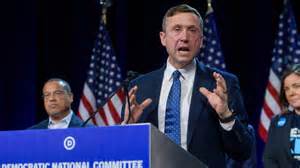
The Democratic National Committee’s leadership turmoil has intensified as Chairman Ken Martin confronts an internal human-resources inquiry following an incident earlier this month in which he reportedly threw his phone toward the desk of a junior aide. While the device did not strike the staffer, it landed on the aide’s desk according to one source, prompting heightened anxiety among a small group of aides and triggering an official investigation. Martin apologized to the affected staff member during a meeting with HR the following business day, but the episode has become emblematic of deeper institutional instability.
Official campaign-finance filings reveal the DNC’s dire financial position: it ended June with $16,332,932.78 in cash and $18,510,798.98 in debts and loans owed. After accounting for liabilities, the committee operates at approximately a $2.18 million deficit—a figure that has become viral shorthand despite the party’s total debt exceeding $18.51 million. In stark contrast, the Republican National Committee held $128,538,880.11 in cash with no reported debt as of the same month. The RNC’s financial advantage represents nearly eight times the DNC’s liquid resources.
Since January 2025, the DNC has recorded $207.4 million in receipts against $213.2 million in disbursements, while the RNC has generated $278.6 million in revenue and spent only $188.1 million. Compounding these challenges, the party’s Washington headquarters serves as collateral for a $15 million line of credit secured last year—a practice it claims has been repeated across previous election cycles.
Martin defended the DNC’s financial strategy in a July 21 statement, asserting that its fundraising performance represents the strongest out-of-power campaign cycle in history and that strategic spending on infrastructure outweighed short-term cash accumulation. His remarks coincided with reports that senior DNC officials were asked to sign nondisclosure agreements ahead of private discussions about committee finances—a departure from prior protocols.
Democratic strategist Adam Jentleson recently stated: “Ken Martin’s tenure is effectively over, it’s clear no one respects him and he is terrible at the job.” The dual crises—leadership instability and financial vulnerability—now converge as Democrats approach the final 100 days before November 3 midterm elections. With the DNC’s balance sheet in disarray and its chairman under scrutiny, the party faces a critical test of whether it can overcome both challenges without compromising its electoral prospects.